Ramallah · Palestine

Khalida Jarrar

خالدة جرار

Parliamentarian · Feminist · Human rights defender

“It is the occupation who must leave our homeland.”

On refusing an Israeli expulsion order, August 2014
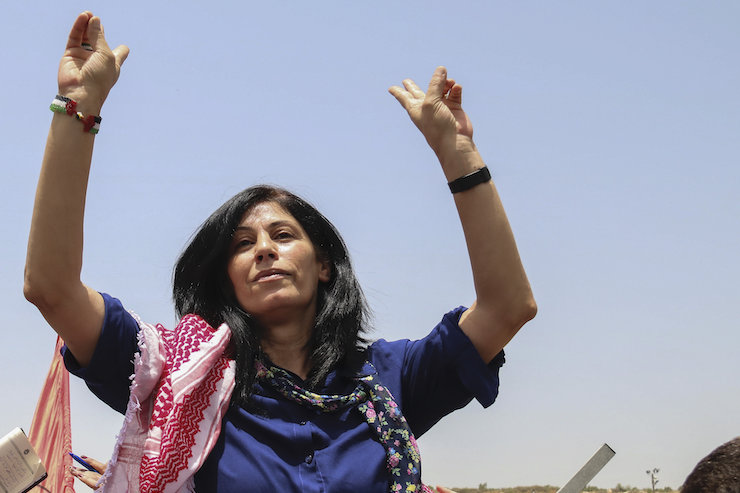
Khalida Jarrar, wearing a keffiyeh, raising both hands in victory signs
Photo: Flash90, 2016
12years leading Addameer, the prisoners’ rights association
2006elected to the Palestinian Legislative Council
5arrests since 1989, years of it without charge or trial
1998the year Israel banned her from travelling abroad

For more than three decades, Khalida Jarrar has stood where the struggle for Palestinian freedom meets the struggle for human dignity: in courtrooms and parliament, at women’s marches, before international tribunals, and in the cells where she has spent years of her life. Through every detention, she has kept the same conviction: a people under occupation has the right to resist it, to document it, and to be free of it.

What she stands for

Six principles of a life’s work

01

Freedom from occupation

An end to the Israeli occupation and full self-determination for the Palestinian people. To her, protest is not a privilege granted by an occupier but a right.

“I represent a people and my people are under occupation and it is my right to protest.”
02

Freedom for prisoners

Her central cause: the release of Palestinian political prisoners, and an end to administrative detention, the practice of imprisoning people indefinitely without charge or trial on the basis of secret files.

“This is the problem with military law: being Palestinian is sufficient grounds for detention.”
03

Women’s liberation

A lifelong feminist, she sees the liberation of women and the liberation of Palestine as one struggle. Her first arrest came at an International Women’s Day march in 1989.

“There is nothing like being free. It gives me the strength to continue fighting for imprisoned women.”
04

Education as resistance

Inside prison she organised classes so that young women detainees could keep learning and sit their matriculation exams. She calls learning an act of defiance and a source of power.

“For us Palestinians, education is our greatest weapon. With it, we will always be victorious.”
05

Accountability under international law

She played a leading role in Palestine’s accession to the International Criminal Court in 2015, and testified to the UN’s Goldstone inquiry by telephone after she was barred from leaving the West Bank.

“Therefore we demand to put an end to this illegal practice.”
06

Unity & democratic renewal

She calls for ending the Palestinian political divide, holding elections and referendums, and building a unified popular leadership accountable to ordinary people.

“We need a leadership that is closer to the Palestinian street.”

Her life

From Nablus to the Legislative Council

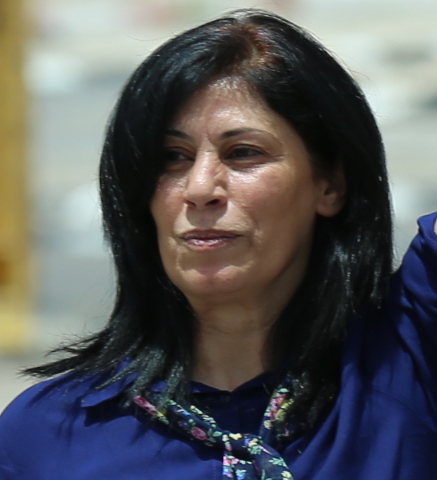
Portrait of Khalida Jarrar in a blue blouse and floral scarf
June 2016 · Photo: Zaher333, CC BY-SA 4.0

Roots

Khalida Jarrar was born in Nablus, in the northern West Bank, on 9 February 1963. Her father ran a toy shop business in the city. As a teenager she volunteered to clean local and public schools, an early sign of the community work that would shape her life.

She studied at Birzeit University, earning a bachelor’s degree in business administration and a master’s degree in democracy and human rights. In 1985 she married Ghassan Jarrar, a fellow student. He has himself been detained more than ten times. The family made its home in al-Bireh, Ramallah.

Defending the detained

From 1993 to 2005 she directed Addameer Prisoner Support and Human Rights Association in Ramallah, documenting conditions in detention, supporting prisoners and their families, and bringing their cases to international bodies. She remains on its board. She has also worked with UNRWA.

Her advocacy carried her to international forums, until Israel imposed a travel ban on her in 1998, after a human rights summit in Paris. Repeated requests to travel since then have been refused.

An elected voice

In January 2006 she was elected to the Palestinian Legislative Council as one of three deputies for the Popular Front for the Liberation of Palestine, the first woman to win a seat for the party. She took charge of the Council’s Prisoners Committee and served as a Palestinian representative to the Parliamentary Assembly of the Council of Europe.

She carried the case for accountability into international law, playing a leading role in the campaign that brought Palestine into the International Criminal Court in 2015.

The price of conviction

Her work has cost her years of her life. She has been arrested five times, held repeatedly in administrative detention without charge, and barred from the funerals of her father in 2015, her mother in 2018, and her daughter Suha in 2021.

Most recently she was held from December 2023 to January 2025, including six months in solitary confinement. Each time she has been released, she has returned to the same cause.
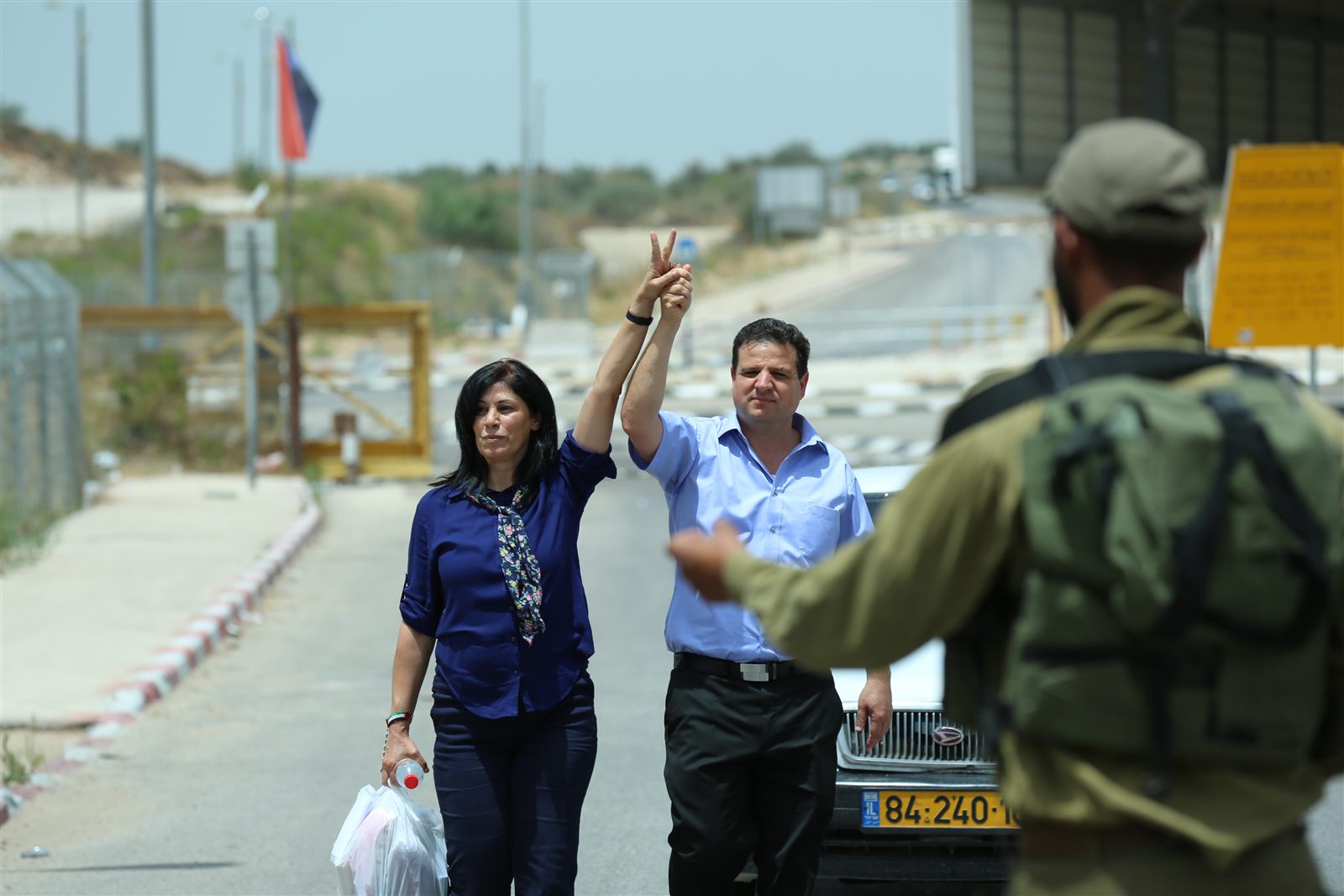
Khalida Jarrar raises a victory sign, hand in hand with Ayman Odeh, as she walks out past an Israeli soldier at a military checkpoint
3 June 2016 Walking free after fourteen months in Israeli prison, hand raised with Knesset member Ayman Odeh. Photo: Zaher333, CC BY-SA 4.0

“Hope in prison is like a flower that grows out of a stone.”

Khalida Jarrar, These Chains Will Be Broken (2019)

Her journey

Six decades, one struggle

  1. Born in Nablus

    Born 9 February in the northern West Bank.

  2. Birzeit & marriage

    Marries Ghassan Jarrar, a fellow student at Birzeit University.

  3. First arrest

    Detained on 8 March at an International Women’s Day demonstration.

  4. Director of Addameer

    Begins twelve years leading the prisoners’ rights association.

  5. Travel ban

    Barred from leaving the occupied territories after attending a human rights summit in Paris.

  6. Elected to parliament

    Wins a seat on the Palestinian Legislative Council and heads its Prisoners Committee.

  7. Testimony to the UN

    Gives evidence to the Goldstone inquiry by telephone after she is denied permission to travel.

  8. Refuses expulsion

    Rejects an Israeli military order to leave Ramallah for Jericho, and stays.

  9. Arrest & the ICC

    The year Palestine joins the International Criminal Court, she is arrested in April and sentenced to 15 months in December. She is released in June 2016.

  10. 20 months without trial

    Held in administrative detention from July 2017 to February 2019, without charge or trial.

  11. Arrested again

    Taken in a 3 a.m. raid in October. In March 2021, under a plea bargain, she begins serving a two-year sentence.

  12. Suha

    Her daughter Suha dies in July, aged 31. Israel refuses her request to attend the funeral. She is released on 26 September.

  13. Fifth arrest

    Seized on 26 December and placed in administrative detention, then moved in August 2024 to solitary confinement at Neve Tirza.

  14. Free

    Released on 19 January in the prisoner exchange under the Gaza ceasefire agreement.

Behind the walls

The Cohort of Defiance

In prison, Jarrar turned confinement into a classroom. Working with fellow detainees, she organised lessons so that young women and girls held in Israeli jails could continue their studies and sit the Palestinian matriculation exam, an initiative she describes as “the first such initiative in the history of Palestinian women prisoners in Israeli jails.”

Each graduating group carried a name. One of them was called “The Cohort of Defiance.”

“For me, education for Palestinian female prisoners became an urgent priority.”

Solitary, 2024

In August 2024 she was moved into isolation at Neve Tirza prison, into a cell of roughly two metres by one and a half with no ventilation. Rights groups reported that she lay on the floor to breathe the air coming under the door. She called her isolation “a political decision and an act of retaliation.”

After her release in January 2025, she spoke for the women and men still held:

“I spent six months in solitary confinement … many Palestinians are held in solitary cells in very harsh conditions.”

In memory

Suha Jarrar d. July 2021

Suha was an environmental and human rights researcher with a master’s degree in climate change science and policy. She died suddenly in July 2021, aged 31, while her mother was in prison. Israel refused Khalida permission to say goodbye. From her cell she wrote a farewell letter that was carried out of the prison and read at the funeral.

“They denied me a farewell kiss, so I bid you farewell with a rose.”

In her words

Voice of the steadfast

Further reading

Sources